Get to know NAC’s Executive Director: Oded Holzinger
By Natural Areas Conservancy on February 12, 2026
By Natural Areas Conservancy on February 12, 2026
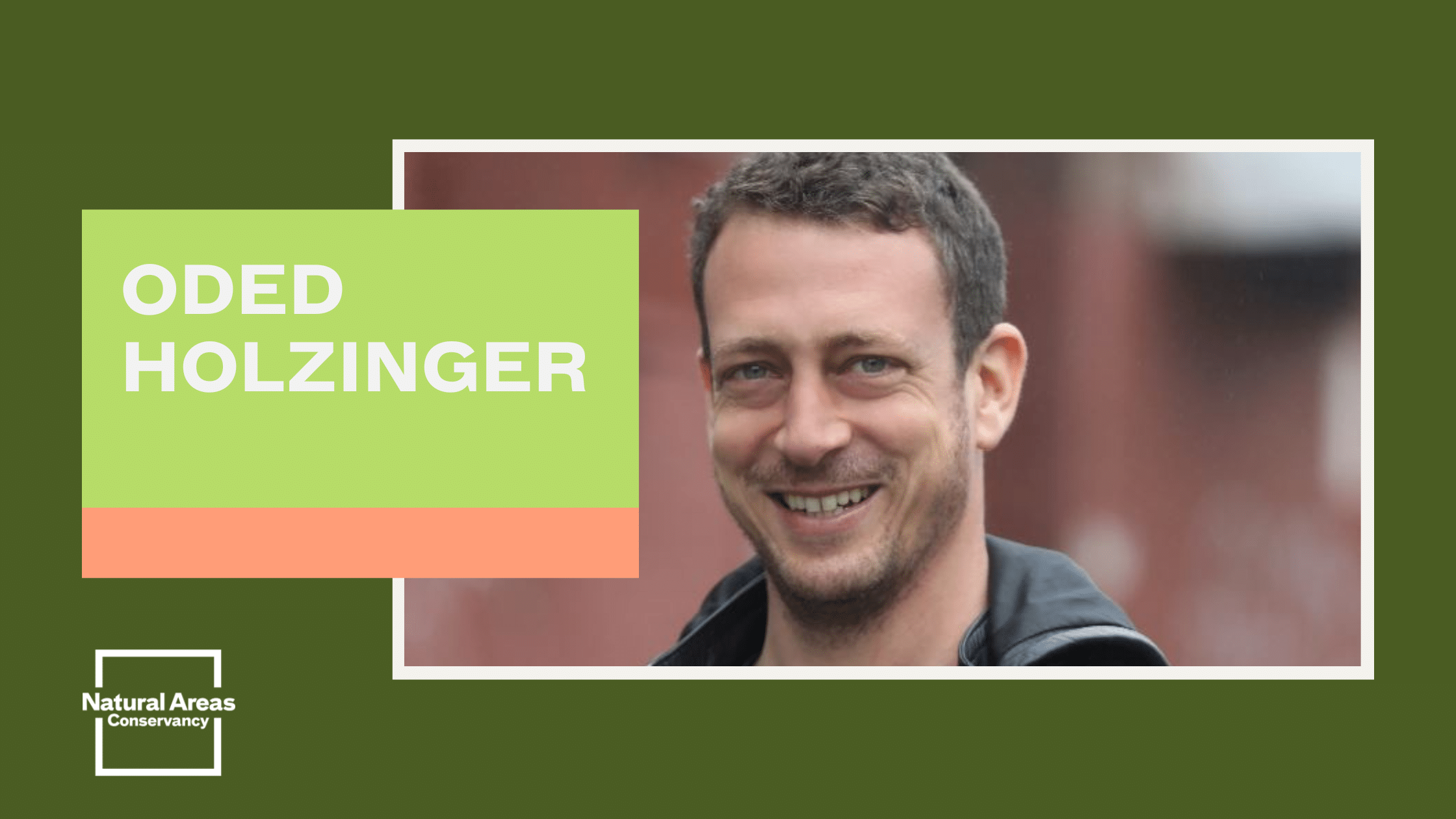
In February 2026, the Natural Areas Conservancy welcomed a new Executive Director, Oded Holzinger! Oded is a climate resilience and urban conservation professional with more than 15 years of experience advancing equity-centered strategies that strengthen communities and natural systems.
His work focuses on translating research, policy, and community priorities into practical, place-based action. Before joining the NAC, Oded served as Executive Director of Groundwork Hudson Valley, where he led the organization’s work in community-based climate adaptation, sustainability education, youth leadership, and environmental restoration.
Read on below for our Q&A with Oded to learn more about his journey and future vision for the NAC.
OH: I grew up with a deep love for both cities and the outdoors. My childhood home was on the edge of a small city, which meant I could walk 20 minutes to meet friends downtown or five minutes to be surrounded by nature. That balance stayed with me. Whenever I traveled, I was usually drawn first to cities—but once there, I’d quickly find myself in a local park or along a waterfront, curious about how the city, its people, and the natural environment interacted.
For a long time, I thought my passion for urbanism and my love of nature were in tension with one another. Over time—through living in different cities, working as an outdoor educator with urban communities, and studying urban geography and planning—I came to understand how deeply connected they really are. Cities are essential to environmental conservation and climate mitigation, and healthy, accessible urban natural areas are critical if cities are going to be just, resilient, and sustainable.
I believe that honoring the Earth requires cities that limit sprawl, and honoring human society requires cities that are woven together with nature—places where all residents have access to something deeply human and primal: direct interaction with the natural world.
When I moved to New York City in 2015 to study urban planning at Hunter College, it was just a few years after Hurricane Sandy. That moment helped shape my professional path and solidified my focus on climate-adaptive urbanism. Since then, my work has centered on the intersection of environmental conservation, climate adaptation, and equity.
OH: I spent much of my twenties working as an outdoor educator with a nonprofit organization serving urban communities, and later as a regional manager overseeing programs across multiple cities. That experience strongly shaped how I think about urban environmental conservation today.
In my early work, I used local forests as spaces for learning, healing, and personal growth with a wide range of marginalized communities. I saw how transformative these experiences could be, especially for young people who had rarely—or never—spent time in natural areas. At the same time, I became deeply aware of how uneven access to those spaces was, and how closely that access was tied to the condition of the landscapes themselves. Many of the places we worked were under-resourced or ecologically stressed, which made it clear that meaningful access depends on healthy, well-managed natural areas.
As I moved into a regional role and worked across multiple cities, those patterns became even clearer. I began to see how planning decisions, funding priorities, and long-term management strategies shape both who gets to experience nature and whether those natural areas are conserved and resilient over time. That experience pushed me to think more systemically and ultimately led me to study urban planning and to seek a professional path that brings together equity, conservation, and stewardship.
OH: New York City has been my home for the past 11 years, and I genuinely believe it’s the greatest city in the world. People who know me—especially those who know how important my connection to nature is—often ask how I manage to live in such a dense, fast-paced place. Sometimes those questions even come from New Yorkers themselves.
I think that’s because when many people picture New York City, they don’t think about its forests, wetlands, and meadows. They don’t always realize just how much nature exists here, or how essential those natural areas are to the city’s identity and to the well-being of New Yorkers.
That’s what resonates so strongly with me about NAC’s mission. NAC is helping strengthen New York City’s identity as a city of nature, while also deepening the connection that New Yorkers have to the natural areas in their neighborhoods. That work—grounded in science, partnership with NYC Parks, and a long-term vision for stewardship—feels incredibly aligned with both my values and my lived experience in this city.
I’m especially excited about 2026 because it marks a real shift toward implementation. Over many years, NAC and NYC Parks have built an extraordinary foundation of research, planning, and ecological frameworks. Now, we’re entering a period where much of that work will increasingly come to life on the ground across parks in all five boroughs.
OH: I’m eager to see how the Forest Management Framework and other research-driven tools guide real-world restoration and management, and just as importantly, what we learn through that process. There’s something powerful about moving from planning to action—and then using those lessons to continue refining how we care for the city’s natural areas over the long term.
OH: Over the last seven years, through my work in Southwest Yonkers just north of Van Cortlandt Park’s Northwest Forest, I fell in love with the incredible sense of wilderness that this landscape offers to the extremely diverse communities that surround it. Through my work there, I often found myself getting lost in the wooded hills in different seasons. Returning to the same forest again and again and watching it change over time never stops amazing me.
Stay up to date on all things NAC by signing up to our mailing list.